What Is Economic Water Scarcity (and How Does It Impact Communities)?
Economic water scarcity occurs when communities have access to freshwater sources, but lack the financial resources, infrastructure, or institutional capacity to deliver clean water to the people who need it. Unlike physical water scarcity, where water simply doesn’t exist in sufficient quantities, economic scarcity means the water is there, but poverty, inequality, and inadequate investment keep it out of reach.
This distinction matters deeply. Right now, more than 1.6 billion people live in regions facing economic water scarcity. These communities watch rivers flow past their homes and know groundwater lies beneath their feet, yet families still walk hours each day to collect water from unsafe sources. Children miss school. Women sacrifice income-earning opportunities. Preventable waterborne diseases claim lives, not because nature failed to provide water, but because economic barriers stand in the way.
Understanding economic water scarcity reveals something hopeful: the solution often lies not in discovering new water sources, but in removing the financial and systemic obstacles that prevent communities from accessing what already exists. A well might cost just a few thousand dollars to drill. A pipe extension could connect an entire neighborhood to an existing water system. Small loans can help families afford the connection fees that separate them from safe water.
This article will guide you through what economic water scarcity really means, how it operates differently from physical scarcity, and why this particular challenge responds so well to targeted, practical solutions. You’ll discover the specific mechanisms that create economic barriers to water access, meet communities transforming their futures through affordable financing, and learn why addressing economic water scarcity represents one of the most cost-effective ways to improve millions of lives.
The water is there. The question is how we help people reach it.
What Economic Water Scarcity Means
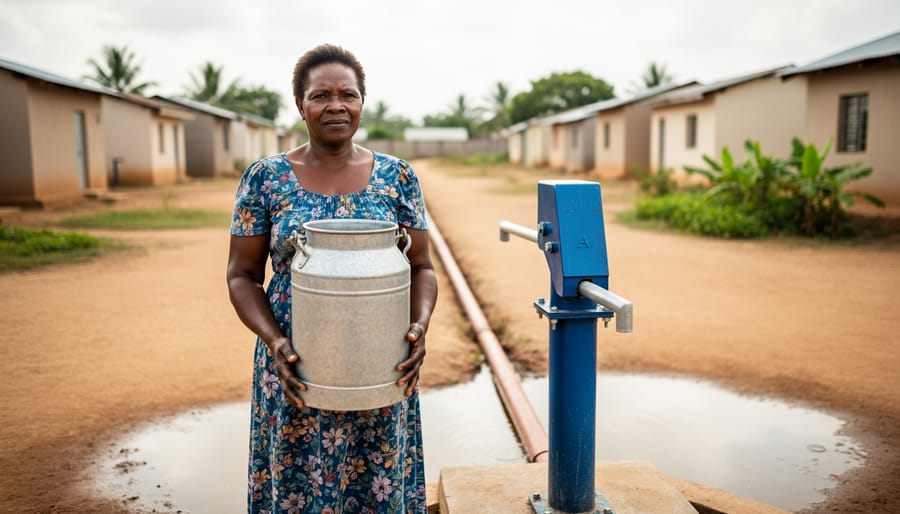
Economic water scarcity happens when water exists nearby but people can’t access it because they lack the money, pipes, or treatment systems to bring it home. Unlike physical water scarcity, where there simply isn’t enough water in the environment, economic water scarcity means the water is there, the technology to access it exists, but communities can’t afford to build or maintain the infrastructure needed to reach it.
This distinction matters enormously. A village might sit near a river or above a groundwater source, yet families still walk hours each day to collect contaminated water from distant wells because no one has built the pipes, pumps, or treatment facilities to make the nearby source safe and accessible. The barrier isn’t nature; it’s economics.
- Economic water scarcity
- When water is physically available but communities cannot access it due to lack of financial resources, infrastructure, or technology to capture, treat, and distribute it.
- Physical water scarcity
- When there is genuinely insufficient water in the environment to meet human and ecological needs, regardless of available infrastructure or funding.
- Water infrastructure
- The systems of pipes, pumps, treatment plants, storage tanks, and distribution networks required to deliver clean water from its source to homes and businesses.
- Potable water access
- The ability to obtain water that is safe to drink, typically meaning it has been treated to remove pathogens and contaminants and is available within reasonable distance of home.
The scale of this challenge is staggering. Globally, 1 in 4 lack safely managed water and the majority of these people live in areas where water sources exist but remain out of reach. In sub-Saharan Africa and parts of South Asia, entire communities face this paradox daily: water flows beneath their feet or past their villages, yet taps stay dry because no one can afford the wells, the pipes, or the purification systems.
Economic water scarcity traps families in cycles of illness and poverty, forcing women and children to spend twenty hours a week fetching water instead of working or attending school. The cruel irony is that solving this problem requires money upfront, exactly what these communities lack.
How Economic Water Scarcity Works
The Infrastructure Gap
In rural Kenya, the Mwangi family watches the sunrise illuminate Lake Naivasha less than three kilometers from their home. Yet every morning, twelve-year-old Grace walks nearly an hour in the opposite direction to fetch water from a hand-dug well, filling jerrycans with murky water that makes her younger siblings sick. The lake’s fresh water might as well be on another continent.
This paradox defines the infrastructure gap at the heart of economic water scarcity. Without pipes to transport water, treatment facilities to purify it, or distribution systems to deliver it reliably, communities cannot access sources that lie tantalizingly close. In the United States alone, the drinking water infrastructure gap requires an estimated $625 billion investment over the next decade just to maintain existing systems and replace aging pipes that lose billions of gallons through leaks.
The problem multiplies in developing regions where infrastructure was never built in the first place. Broken hand pumps sit idle for months awaiting parts. Treatment plants remain half-finished for lack of funding. Distribution networks stop at neighborhood boundaries, leaving informal settlements disconnected. When pipes do exist, they often deteriorate from poor maintenance, turning clean sources into contaminated flows.
For the Mwangi family and millions like them, the water crisis isn’t about drought or empty aquifers. It’s about the missing links between abundant water and their kitchen taps.
Financial and Institutional Barriers
Beyond crumbling pipes and missing treatment plants, economic water scarcity persists because communities often can’t secure the funding needed to build or repair infrastructure. Traditional lending institutions view water projects in low-income areas as too risky, leaving families trapped in a gap where they’re too poor to afford upfront construction costs but earn enough to repay small loans over time. A mother in rural Kenya might live just two kilometers from a borehole that could deliver clean water to her home, but without access to affordable credit, that proximity means nothing.
Weak governance compounds these financial barriers. When local institutions lack technical expertise, transparent procurement systems, or long-term maintenance plans, even donated infrastructure falls into disrepair within years. Corruption and mismanagement divert funds meant for water systems, while unclear property rights and conflicting bureaucratic jurisdictions stall projects indefinitely.
Yet innovative financing models are proving these barriers aren’t insurmountable. Microfinance institutions now offer water credit, small loans specifically designed for household water connections, toilets, and storage systems. These loans, typically $150 to $500, allow families to pay for infrastructure in affordable monthly installments rather than impossible lump sums. Repayment rates exceed ninety percent because water access generates immediate savings: families no longer purchase expensive water from vendors or lose income to waterborne illness. This approach transforms water from an unattainable dream into an achievable investment, breaking the cycle that keeps available water just out of reach.
Forms of Economic Water Scarcity
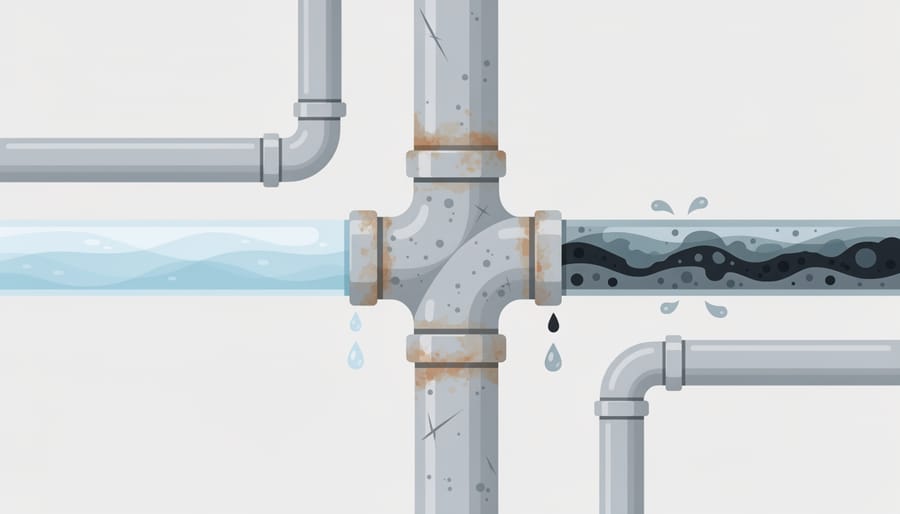
Economic water scarcity manifests differently across contexts, but each form reveals the same underlying truth: infrastructure and financing gaps, not water availability itself, keep communities from accessing clean water.
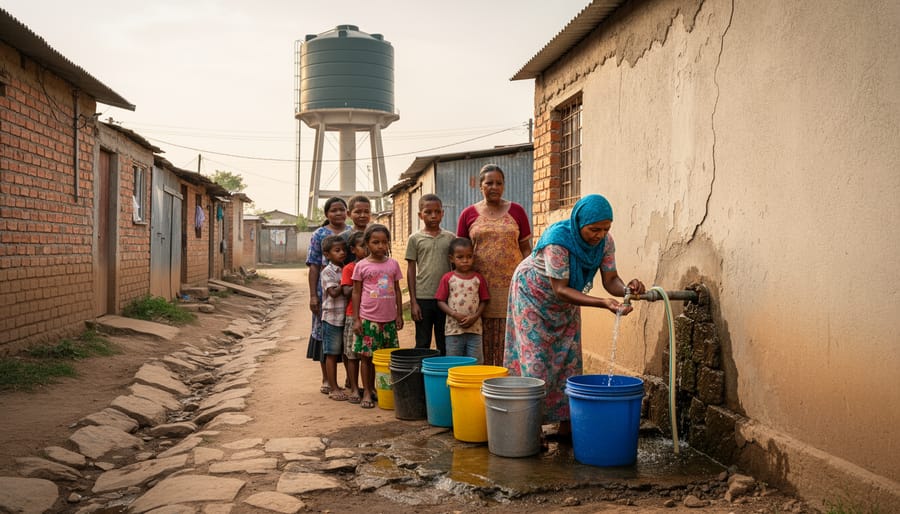
In urban informal settlements and slums, millions of people live within sight of modern water systems they cannot access. Homes in these communities often lack legal addresses or property titles, making them ineligible for municipal water connections. Even where connections are possible, upfront installation costs of $200 to $500 place them beyond reach for families earning just dollars per day. Residents instead purchase water from vendors at prices ten to twenty times higher than piped rates, spending up to 30 percent of household income on water that wealthier neighbors get for a fraction of the cost. Kibera in Nairobi and the favelas of São Paulo illustrate how proximity to infrastructure means nothing without the financial means to connect.
Rural communities face a different challenge: water sources exist nearby, but no infrastructure bridges the gap between source and home. A village might have a river half a kilometer away or groundwater accessible through drilling, yet families still walk hours daily because the community lacks funds for wells, pumps, or pipes. The water is there. The technology to access it exists. What is missing is capital investment. This is precisely where innovative banking solutions are making a difference, enabling families to finance infrastructure through affordable microloans that turn distant water sources into household taps.
Contamination represents another manifestation. Many communities have water sources that could serve them safely with proper treatment, but lack the facilities to remove pathogens, chemicals, or sediment. Surface water sits unused because no filtration system exists. Shallow wells remain idle because no one can afford chlorination. The gap between available water and safe water is purely economic.
Seasonal infrastructure failures reveal how economic water scarcity operates on a timeline. Systems work during dry seasons when demand is manageable, then collapse under pressure during peak usage periods or fail completely during floods that overwhelm inadequate drainage and treatment capacity. These breakdowns trace back to underfunded maintenance and systems built below needed specifications.
Where Economic Water Scarcity Impacts Lives
Economic water scarcity touches lives in distinct patterns across the globe, concentrating most heavily where infrastructure investment has lagged behind population growth and development needs. Understanding where this challenge manifests most acutely helps direct resources where they will create the greatest impact.
The geography of economic water scarcity includes several primary contexts:
- Sub-Saharan Africa, where 40% of the population lacks access to basic water services despite adequate rainfall in many regions
- South Asia, particularly rural areas of India, Bangladesh, and Pakistan where infrastructure cannot reach dispersed communities
- Rural Latin America, where mountainous terrain and distance make water system development costly
- Urban informal settlements globally, where rapid migration outpaces municipal water network expansion
- Post-conflict and fragile states where governance weaknesses prevent infrastructure maintenance and investment
In developing countries, the pattern is clear: water exists, but the pipes, pumps, and treatment facilities to deliver it do not. Over 780 million people worldwide live within reach of water sources that remain inaccessible because communities cannot afford the infrastructure to harness them. This isn’t about drought or depleted aquifers. It’s about families watching rivers flow past their homes while children walk hours to collect contaminated water from unprotected sources.
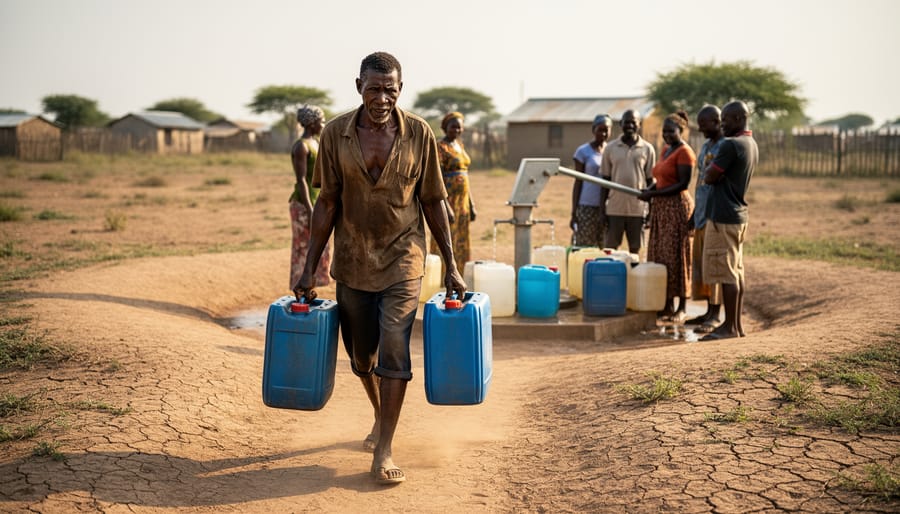
Rural communities face particularly acute challenges. Twenty-three-year-old Fatima in rural Ethiopia lives just two kilometers from a seasonal river, but without a protected well or distribution system, she spends four hours daily collecting water from a contaminated surface source. This time burden falls almost exclusively on women and girls, translating to 40 billion working hours lost annually across Africa alone.
Informal urban settlements present a different face of the same problem. In Nairobi’s Kibera settlement, residents live surrounded by the city’s water infrastructure yet pay ten times more than wealthy neighborhoods for water delivered by vendors in jerry cans. The proximity of both water sources and water pollution from inadequate sanitation creates a cruel irony where families spend 20% of their income on unsafe water.
The health impact on children tells the starkest story. In communities facing economic water scarcity, children under five suffer twice the rate of diarrheal disease compared to areas with adequate infrastructure, costing families both healthcare expenses and lost income from caring for sick children. Each dollar invested in water infrastructure in these contexts returns $4 to $12 in economic benefits through improved health, time savings, and expanded opportunities.
The Economic Ripple Effects
Economic water scarcity creates waves of economic hardship that extend far beyond the immediate challenge of accessing clean water. When communities can’t afford the infrastructure to reach available water sources, they pay a hidden tax measured in time, health, and lost opportunity.
Women and girls bear the heaviest burden. Families without nearby water access spend an average of 200 million hours daily collecting water. That’s time stripped from income-generating work, from running small businesses, from caring for children. In rural Kenya, women who previously walked six hours daily for water now earn income from market stalls and sewing after their community gained piped access. One extra hour saved translates to real money that feeds families.
Children suffer doubly. When they haul water instead of attending school, their future earning potential shrinks. Studies show girls in communities with distant water sources miss nearly 20 percent more school days than boys. The educational gap compounds over years, limiting career options and perpetuating poverty cycles.
Healthcare costs drain household budgets. Families facing economic water scarcity often choose between paying for contaminated but available water or walking hours to cleaner sources. Waterborne illnesses from unsafe water cost African nations alone $28.4 billion annually in healthcare expenses and lost productivity. A mother spending her earnings on treating her child’s diarrhea can’t invest in seeds, school fees, or growing her business.
Agricultural potential withers. Smallholder farmers with water sources nearby but no pumps or irrigation systems watch their neighbors’ irrigated fields flourish while their own yields remain minimal. That gap represents not just lost income but reduced food security for entire regions.
Yet these ripple effects reverse dramatically when economic water scarcity gets solved. Access to affordable financing for water infrastructure doesn’t just deliver water, it unlocks time for work, health for productivity, and opportunity for growth. Communities that overcome economic water scarcity consistently see household incomes rise within the first year.
Solutions That Bring Hope
Economic water scarcity can feel overwhelming, but it’s fundamentally different from other development challenges because proven solutions exist today. Unlike physical water scarcity that requires finding new water sources, economic water scarcity responds directly to financial innovation and smart investment.
The most transformative approach has been affordable financing that puts control in people’s hands. Small loans, typically $150 to $300, enable families to install household water connections, construct toilets, or drill shallow wells. Since 2003, these microloans have helped over 60 million people gain water access. Families repay loans through savings from no longer purchasing expensive water from vendors, creating a sustainable cycle rather than dependency. A mother in Kenya who once spent three hours daily collecting water can now earn income during that time, easily covering her small monthly loan payment while transforming her family’s health and economic prospects.
Community-led infrastructure projects harness local knowledge and investment. When residents contribute labor, materials, or funds alongside external support, ownership and maintenance improve dramatically. In rural India, village water committees manage systems, collect modest fees for upkeep, and make decisions about expansion, ensuring infrastructure survives beyond the initial installation.
Public-private partnerships bridge the gap between government responsibility and private sector efficiency. These collaborations bring technical expertise and capital to underserved areas while maintaining affordability through smart subsidy design. One partnership in the Philippines extended piped water to 200,000 previously unserved residents by combining utility expertise with development funding.
Appropriate technology matters as much as financing. Gravity-fed systems, biosand filters, and solar-powered pumps work in contexts where complex treatment plants would fail due to maintenance costs or electricity limitations. The key is matching technology to local capacity and resources.
Capacity building ensures solutions last. Training local technicians, supporting water committees, and strengthening governance creates communities that can maintain and expand their systems. These comprehensive water and sanitation interventions address not just hardware but the institutional foundations for long-term success. When a Ugandan community learns to repair their own pump and manage their water fund, they’ve gained permanent capability, not temporary relief.
Common Questions About Economic Water Scarcity
Economic water scarcity raises practical questions that deserve clear, honest answers. Understanding these common concerns helps illuminate both the challenge and the real solutions already changing lives.
How is economic water scarcity different from drought?
Drought means water physically isn’t available in an area, while economic water scarcity means water exists nearby but communities lack the infrastructure or financial resources to access it. A well might be 500 meters away, but without pipes or pumps, families still carry contaminated water from distant sources.
Can’t governments just provide free water infrastructure?
Many governments lack the budget for widespread water systems, and free provisions often fail without local ownership and maintenance capacity. Sustainable solutions combine public investment with community participation and affordable financing that gives families dignity and stake in their water access.
How much does it actually cost to solve economic water scarcity for a family?
A household water connection typically costs $200-500, and a small loan of $150-300 can cover a toilet or water storage system. These amounts seem modest, but they represent months of income for families earning $2 daily, making microfinance crucial.
How do loans help poor communities afford water solutions?
Small, affordable loans let families pay for water connections over time while immediately gaining health benefits and time savings. Women no longer spend hours daily fetching water, children attend school instead of falling ill, and repayment builds financial dignity and credit access.
What role can individuals play in addressing this challenge?
Supporting organizations that provide water financing, advocating for smart development policies, and raising awareness all create impact. Every contribution toward affordable water access helps prove that when communities gain the resources they need, clean water changes everything from health to economic opportunity.
These questions reflect genuine concerns, but they also point toward encouraging truths. Economic water scarcity persists not because solutions are unknown or unaffordable at scale, but because resources haven’t been directed effectively. The families facing this challenge don’t need charity alone, they need access to the same financing tools and infrastructure investments that transformed water access in wealthy nations generations ago.
Economic water scarcity isn’t a problem without solutions. Unlike droughts or depleted aquifers, this challenge stems from gaps we know how to fill: infrastructure we can build, financing we can provide, systems we can strengthen. The proof lives in communities that once spent hours fetching water but now turn on taps in their homes, in children who attend school instead of carrying jerrycans, in women who launch small businesses with time they’ve reclaimed.
The transformation happens through investment, not charity. When families gain access to affordable financing, they choose to connect to water systems, install household taps, and build sanitation facilities. These aren’t handouts but partnerships that recognize people’s capacity to improve their own lives when given the right tools. Communities that receive both infrastructure support and financial access don’t just solve their water crisis, they unlock economic potential that ripples through generations.
You have the power to break the cycle of water poverty. Supporting organizations that provide water credit and infrastructure financing means your contribution multiplies. A single investment helps a family connect to clean water, which improves health, creates time for income-generating work, and allows children to focus on education. These families then repay their small loans, creating funds that help the next family, and the next.
Picture a world where no parent watches their child fall ill from contaminated water, where no woman sacrifices her dreams to hours of water collection, where every community has the infrastructure to access the clean water that exists nearby. That world is within reach. Economic water scarcity ends not when we find more water, but when we invest in the people who need it most.